
Fake News on Social Media Turns Us Against Brands
If you’ve ever shared a negative comment about a product after seeing something suspicious online, you’re not alone. New Romanian research explains exactly why this happens — and how brands can stop the chain reaction.
You’re scrolling through Instagram. Suddenly a post pops up: “Warning! Product X contains dangerous ingredients!” Maybe it’s a screenshot, maybe a viral video. You’re not sure if it’s true, but something bothers you. You close the app with a bitter taste in your mouth and, later, you tell your friends to avoid that brand.
Sound familiar?
Without knowing it, you just went through a psychological cycle that researchers at Babeș-Bolyai University in Cluj-Napoca, Romania, have studied closely. Their findings, recently published in the international journal Computers in Human Behavior, show that fake news about products doesn’t just shape our opinions — it turns us into vocal critics of brands, sometimes without any real reason to be.
What Was Studied, in a Nutshell
The research team — Ovidiu-Ioan Moisescu, Luigia-Gabriela Sterie, and Daniel Mican — surveyed 497 Romanian social media users between the ages of 18 and 34: people who actively follow influencers and see online ads every single day.
The central question: How does fake news about products affect our behavior toward brands? And can this effect be stopped?
The answers are surprising — and at the same time, perfectly logical.
Fake News Makes Us Cynical. Cynicism Makes Us Speak Badly About Brands.
The study identifies a two-step effect, like falling dominoes.
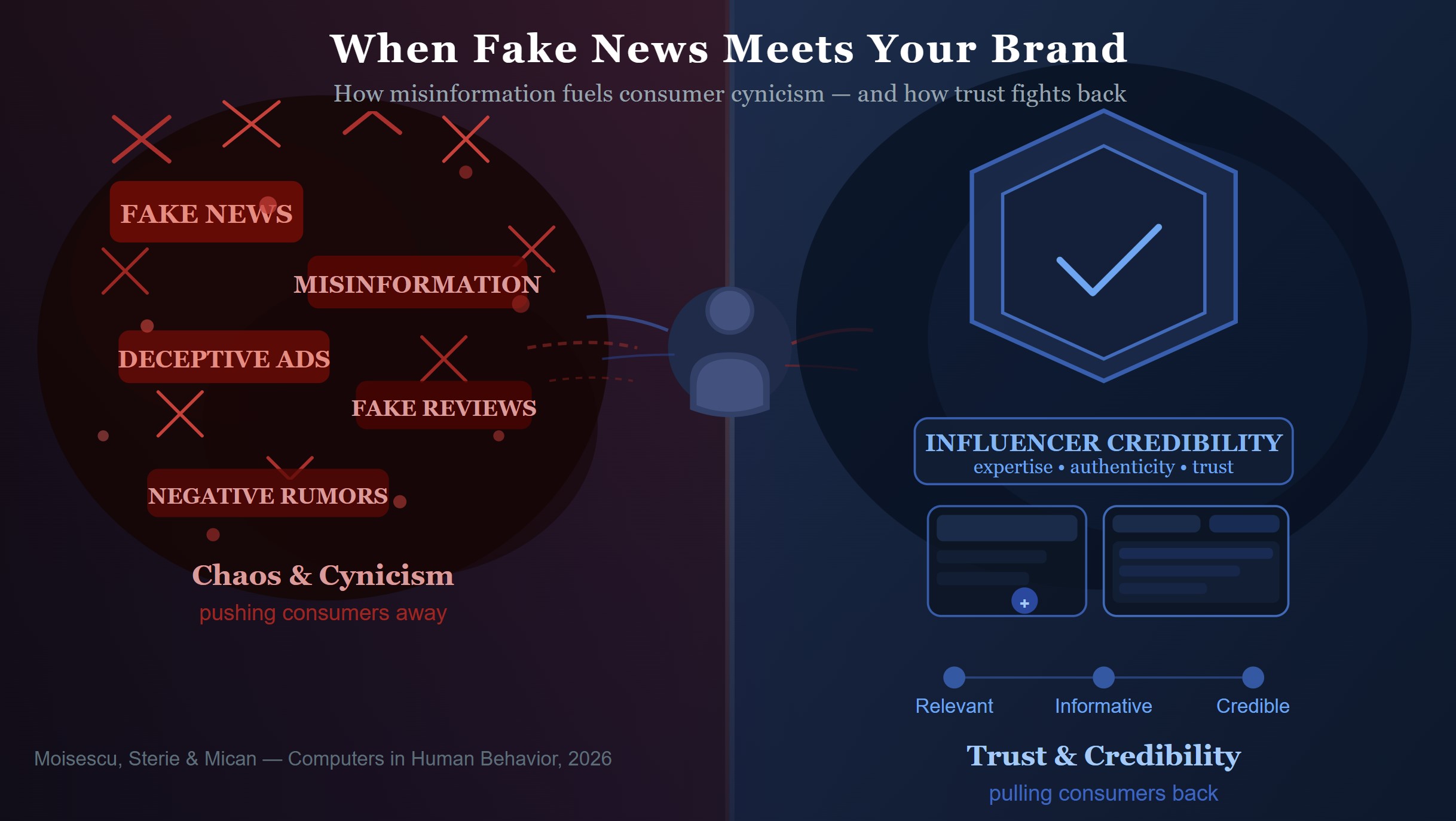
Step 1: When we’re exposed to false or misleading information about a product — whether fabricated ingredients, exaggerated benefits, or invented accusations — we become more cynical about everything marketing-related. We stop believing anything. Not ads, not influencers, not brand messages.
Step 2: That cynicism turns into action. Cynical people speak negatively about products online, discourage friends from buying, and refuse to recommend brands. Researchers call this NWOM (negative word-of-mouth) — the bad kind of word of mouth.
In concrete terms: fake news significantly increases cynicism, and cynicism, in turn, massively amplifies negative behavior toward brands. The total effect of fake news on negative word-of-mouth is one of the strongest in the entire model.
In plain English: If you see an influencer promote a product and later find out something shady about it, you lose trust in that influencer, in similar ads — and you’ll tell others about it too.
Why Do We React This Way? The Psychology Behind It
The researchers didn’t just stop at “what happens” — they explained the “why” as well.
Cognitive dissonance theory tells us that our minds hate contradictions. You believe a brand is trustworthy → you find out it deceived you → a powerful psychological discomfort kicks in. The brain resolves this tension by adopting a defensive stance: “From now on, I don’t trust anyone.”
Psychological contract violation theory adds an emotional layer. When we buy a product, we hold implicit expectations: that the brand is honest, that it won’t manipulate us. When fake news makes us feel those expectations have been broken, we feel betrayed — and betrayal triggers strong reactions, including the urge to publicly “punish” the brand.
Put simply: this isn’t just rational, it’s deeply emotional.
The Good News: There’s an Antidote — and It’s Called “Trust”
If fake news is the fire, trust in advertising is the water. The study shows that people who trust the influencers they follow and the ads they see become significantly less cynical — even after being exposed to false content.
There are two types of trust that matter:
1. Trust in Influencers
Not all influencers are equal. The study shows that three factors genuinely build trust:
- Credibility — the perception that the influencer is honest and doesn’t promote anything that comes their way. This is the most powerful factor in the study.
- Expertise — actually knowing what they’re talking about in their specific niche. Second most important.
- Physical attractiveness — yes, it matters, but far less than the other two. A good-looking influencer who promotes anything won’t build lasting trust.
Practical lesson: If you’re a brand, don’t choose influencers based on follower count or looks. Choose them based on their reputation and genuine knowledge in your industry.
2. Trust in Social Media Ads
Ads matter too, but in a different way. Two factors make the difference:
- Relevance — whether the ad speaks to you, your interests, your lifestyle. Surprisingly, this proved more important than the information itself.
- Informativeness — how clearly and completely the ad explains the product.
Practical lesson: A personalized ad that talks about things you personally care about builds more trust than one packed with data and figures but irrelevant to you.
A Few Numbers That Say It All
Without getting into complex statistics, here’s what the study measured:
- Fake news → cynicism: strong direct effect
- Cynicism → negative word-of-mouth: the strongest effect in the entire model
- Trust in influencer → reduced cynicism: significant effect
- Influencer credibility beats attractiveness by 4x in its impact on trust
- Ad relevance beats informativeness as a predictor of trust
In short: what people say about brands online is massively influenced by how much — or how little — they believe in them.
What This Means for You as a Social Media User
If you’re just a regular user, the study offers a few valuable perspectives:
Be aware of the psychological mechanism. Next time you read something negative about a product, ask yourself: Is this verified? Is it a reliable source? Or am I scrolling past without checking? Fake news is designed to trigger strong emotions, not critical thinking.
Choose influencers wisely, not emotionally. An influencer with 100,000 followers who consistently talks about a specific niche and turns down collaborations that don’t fit their profile is far more trustworthy than one with 2 million followers who promotes detox today, cars tomorrow, and supplements the day after.
Negative information sticks harder. Psychology confirms what we know intuitively: we remember negative things better. This means a single piece of false content can destroy years of carefully built reputation — which is why it matters to verify before sharing.
What This Means for Brands and Marketers
The study comes with concrete recommendations for those in the industry:
Actively monitor what’s being said about you. Don’t wait for a false story to go viral. Social listening tools can detect waves of misinformation early on.
Partner with fact-checkers and verification organizations. A brand that responds quickly and transparently to fake news with clear evidence limits the damage.
Invest in credible influencers, not just popular ones. The right influencer with 50,000 loyal followers can do more than one with 500,000 who posts anything.
Personalize ads authentically. Audiences feel the difference between an ad that “gets them” and one thrown out at random. Relevance isn’t optional — it’s strategic.
You can’t win the fake news battle through ads alone. The study shows that trust reduces negative effects, but doesn’t eliminate them completely. A dual strategy is needed: combating misinformation AND actively building trust.
Conclusion: In a World With More and More Fake News, Those Who Build Real Trust Win
The research from Cluj-Napoca sends a clear message: fake news isn’t just a political or social problem — it’s a business problem, with direct effects on reputation and sales.
But the good news is that we’re not powerless. Consumers who have real reasons to trust — credible influencers, relevant ads, transparent brands — are far more resistant to waves of misinformation.
In an era where anyone can post anything, authenticity isn’t a luxury — it’s the only strategy that works long-term.
Article based on the research: Moisescu, O.-I., Sterie, L.-G., & Mican, D. (2026). Fake news, consumer cynicism and negative word-of-mouth: The mitigating role of trust in social media advertising. Computers in Human Behavior, 175, 108842.

